
Audi Select (Audi on Demand) - Redefining the look and feel of modern car leasing
Background
Subscription models are gaining traction among car owners who prefer flexibility over long-term commitments. Simultaneously, Audi sought to capitalize on their idle, unsold vehicles in dealerships, targeting a younger, aspirational demographic under 35, differing from their usual over-40, high-income customer base.
Thoughts
With several vehicle manufacturers launching subscription services. Audi Select had the potential to stand out for those seeking short-term options, corporate leases, or vacation vehicles. How can we streamline the traditional car buying process?
Problem
In response to the growing demand for flexible car ownership, Audi sought to optimize the use of unsold dealership inventory. Targeting under-35 aspirational buyers, a demographic not fully captured by their existing customer base of high-income earners over 40, Audi aimed to address both vehicle accessibility and their inventory management.
Information Architecture (Insert 43 and 44)
We developed a service design blueprint to pinpoint gaps in user experience, leading to the discovery of new entry points for the consumer platform and essential front-end and back-end processes. A second blueprint focused on operational perspectives, integrating customer actions and operational procedures.
Approach
This project involved analyzing existing services and identifying gaps in the subscription process. Solutions were developed to address these gaps, with concepts tested through UsabilityHub and user interviews. A pilot program was then executed in collaboration with a local DFW dealership (Grapevine Audi) and the Silvercar team.
Outcome
Audi surpassed its initial goal of acquiring 25 subscribers for the Premier Collection at the pilot location within four months, two months ahead of the six-month target. The program introduced the Core Collection at $995 monthly, which quickly generated a waiting list. Plans are underway for Audi select to expand into new markets.
Design Principles
Don’t show if information is not relevant seller’s current situation.
Group items to make simple. For example, group all the relevant items related to listings fee.
Have Clear action item for each state. If there is no action to take, make it clear.
Understanding Pain Points and Setting Goals
In the discovery phase, we analyzed provided Audi data, traditional car buying trends, and reflected on our own purchase challenges.
Target User Base
Audi's typical customers are predominantly 70% college graduates, 60% married, 20% with children, average age of 40, median income of $100,000, with 70% male and 30% female ownership.
Audi Select's Aim
Audi envisioned Audi Select attracting users aged 25-40, not necessarily high earners, drawn to a flexible subscription model. However, usability tests revealed the pricing to be a barrier for this demographic.
User Benefit
Audi Select members start with an introductory rate, followed by a fixed monthly fee covering maintenance and insurance. They can swap vehicles up to twice a month and cancel the service at any time without additional costs.
Key Insights
Importance of concierge service and efficiency in customer interactions for Audi and Silvercar, expected to extend to Audi select.
Audi on-demand in Europe failed primarily due to the local transportation landscape and the unappealing 12-month cost commitment.
Target demographic for Audi - younger, educated college graduates entering the luxury car market. However, this was later revised due to pricing considerations.
Audi's consumer demographics include 70% college graduates, 60% married, 20% with children, median age of 40, median household income of $100,000, with 70% male and 30% female ownership.
Key Needs
Design Efficiency - Prioritizing efficiency in design, reflecting Silvercar's approach.
Customer Management - Reducing reliance on physical paperwork for registrations, cancellations, and swap requests.
Scheduler Feature - Initially planned for version 2, I developed an early design concept.
Mobile Application - Evaluating the necessity of developing a mobile app.
Initial Goals
Grasp Audi select’s business, vision, and strategy. Investigate reasons behind Audi On-Demand's failure in Denmark and Germany and their criteria for success and failure.
Explore typical behaviors of potential and current customers in car purchasing, focusing on their dealership experiences, anticipations, and apprehensions.
Identify factors contributing to a satisfying car buying experience, including concierge services and process efficiency.
Pinpoint major customer frustrations in purchasing, such as sales interactions, trust issues, or wait times.
Examine interactions between sales, management, finance teams, and customers, assessing motivation and its correlation with financial incentives.
Determine customer needs and wants, identifying areas for enhancement.
Research goes here
Research spanned a month, focusing on exploration, research, interviewing, and synthesis.
Audi Consumer Interviews (Insert 30 and 31)
To grasp our target user's perspective, we conducted focused interviews with three Audi owners interested in a car subscription service. This revealed key insights into their preferences, motivations, and issues with the traditional car buying process.
User Insights (Silvercar Experience): Preference for Web over Mobile - Audi users preferred using a web-based platform over mobile for the consumer experience.
Revised Findings
Users appreciated the simplicity of the car leasing process but were frustrated by the lack of customer support during the transaction. They felt uneasy about entering personal information despite the security measures. We recommend integrating Zendesk or Intercom into the booking flow and offering an on-demand concierge service for enhanced trust and assistance.
Information Architecture and User Flow
Research spanned a month, focusing on exploration, research, interviewing, and synthesis.
Design
Research spanned a month, focusing on exploration, research, interviewing, and synthesis.
Design (Insert 45 and 47 above)
The storyboard illustrates the user's journey based on the developed persona, incorporating features and concepts from the ideation session. It serves as a low-fidelity method for evaluating these features and forms the foundation fo.
Testing
Research spanned a month, focusing on exploration, research, interviewing, and synthesis.
Methods Conducted (Insert 27 and 28)
Subject-Matter and User Interviews - Conducted both informal and formal interviews with experts and users to understand their experiences, successes, and challenges in car buying.
Dealership Observations / Diary Study - Accessed and validated user feedback on their dealership experiences, enhancing our understanding of the current scenario.
Subject-Matter and User Interviews - Conducted both informal and formal interviews with experts and users to understand their experiences, successes, and challenges in car buying.
Dealership Observations / Diary Study - Accessed and validated user feedback on their dealership experiences, enhancing our understanding of the current scenario.
Subject Matter Interviews (Primary)
Our initial step involved conducting three interviews with Audi and Silvercar executives to understand their business and product objectives for Audi select. We explored critical questions, such as the reasons behind Audi on-demand's failure in Europe, adjustments for Audi select's success in the U.S., Audi's target demographics, and their metrics for success and failure.
Design Process
Utilizing the Dialexa design methodology, we thoroughly analyzed the conventional car-buying journey, focusing on consumer preferences. Our approach began with extensive user research, which informed the brainstorming and design of various solutions. These concepts were then validated through usability testing, leading to the creation of high-fidelity, interactive prototypes that reflected our insights.
This approach aligned with Audi Select's strategy to revolutionize car ownership. Recognizing the shift towards subscription models, especially among under-35s seeking flexible options, Audi aimed to utilize unsold dealership inventory effectively. Our design process sought to address both Audi's inventory management and the accessibility needs of this emerging demographic.
Role
I conducted user interviews, participated in discovery sessions with stakeholders. Subsequently, I developed and presented both low and high-fidelity interactive prototypes. I was involved alongside two other designers on this project for for 8 months.
User Needs
Time Efficiency - Customers expressed dissatisfaction with the time-consuming aspects of car buying, including waiting for sales interactions, finance discussions, and vehicle detailing. Concierge Service - There's a clear need for attentive customer service, with availability for guidance throughout the process.
Observation Insights
Customers displayed varied facial expressions upon entering the dealership. Frustration was evident among customers in the finance department.
Dealership Observation
During our visit to the Audi pilot dealership, we observed customer behaviors and emotions to validate their reported experiences.
Ideation
Research spanned a month, focusing on exploration, research, interviewing, and synthesis.
Consumer Service Blueprint (Insert 39 and 40)
We developed a service design blueprint to pinpoint gaps in user experience, leading to the discovery of new entry points for the consumer platform and essential front-end and back-end processes. A second blueprint focused on operational perspectives, integrating customer actions and operational procedures.
Group Ideation (Insert 32 and 33 above)
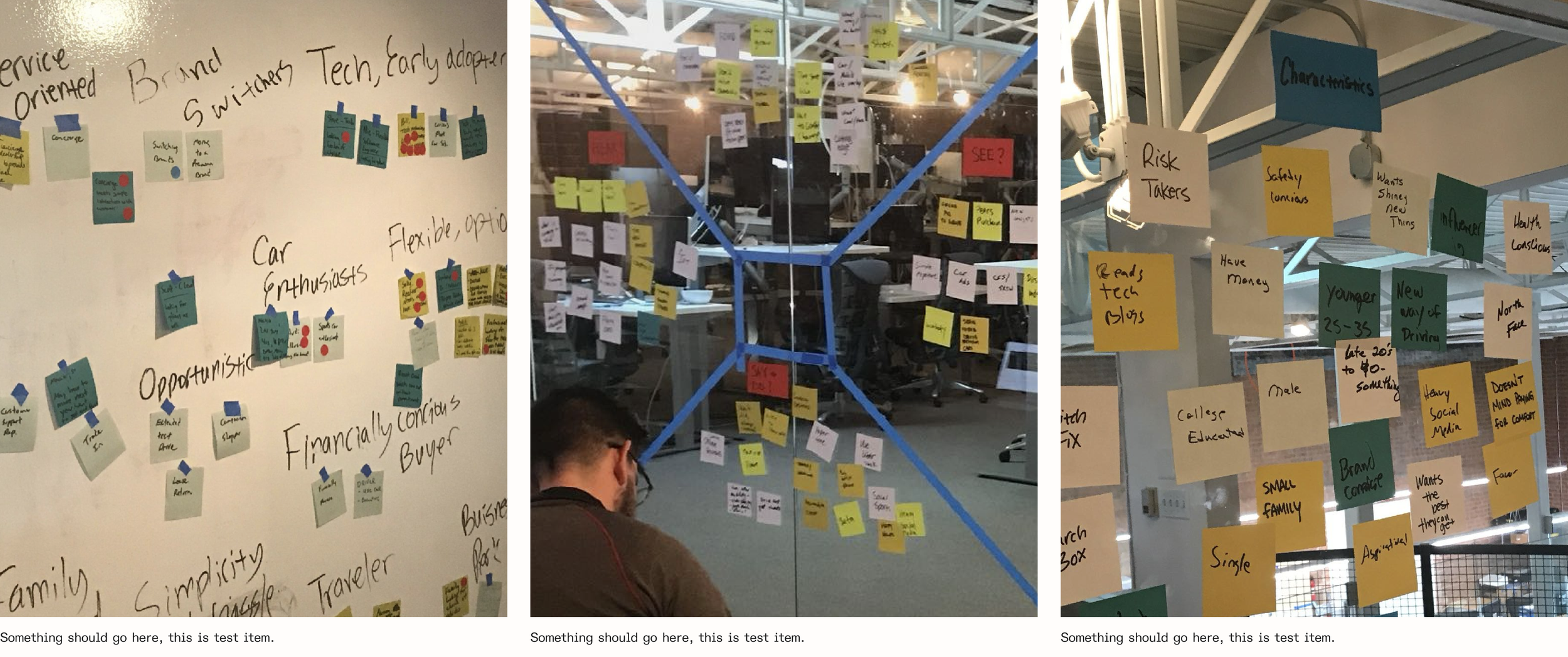
Our objective was to focus on a range of potential solutions and reach team consensus on the most compelling ones. During a three-day brainstorming session in Austin with Audi and Silvercar, we concentrated on identifying and prioritizing user needs for Audi Select's initial phase.
Streamlining the car buying process to an online platform with a clear activation and monthly fee structure.
All-inclusive pricing, covering maintenance and enabling vehicle swaps, initially unlimited, later limited to two swaps per month.
Deploying Silvercar staff to provide a comprehensive concierge service, guiding customers through the online process.
Enabling vehicle swap requests directly on the consumer platform.
Opting to focus on a web-based consumer platform instead of developing a mobile application.
Competitive Analysis (Insert ca Figma chart)
Our research began with an analysis of 7 direct competitors in the car subscription industry. The first step was to build empathy with users and get familiar with the old tool. Based on past researches findings, I created a competitive analysis chart and shared pain points and wishlists with the team.
User Personas (Inset old and new personas)
I developed provisional personas based on user research data to identify buyers needs. Tasked by Silvercar by Audi to cater to an expanding demographic, I focused on creating personas that aligned with both aspirational and expected buyers, guiding the project's direction.
Key Findings
Most services (6/7) included insurance, maintenance, cleaning, and vehicle exchanges at no extra cost.
Only Access by BMW provided corporate memberships.
Most services (6/7) were conducting pilot programs in a single city.
Membership fees varied between $495 and $600, with monthly fees from $700 (Volvo) to $3100 (Book by Cadillac). Audi was noted for its value and selection.
The majority (5/7) offered unlimited mileage, while Volvo and Lexus had a cap of 1,250 miles per month, or 15,000 annually.
Volvo was unique in offering both desktop and mobile platforms, though we questioned the necessity of a mobile app.
Volvo allowed full vehicle customization in its pilot, but faced delivery delays of 1-2 months.
Ideation
In our prototype feedback sessions, we engaged four participants: two aged 23-40 with incomes above $55k, and two aged 40-55 with incomes above $85k, encompassing both aspirational and traditional consumer profiles.
Feedback from older, traditional users indicated they found the design overwhelming and confusing due to a lack of clear instructions. Balancing interaction, language, and typography presented a unique challenge.
These users appreciated the simplicity of the Audi select process but expressed frustration over the absence of customer support, a crucial element considering the involvement of significant financial transactions.
A common concern was discomfort in sharing personal information on the platform, despite emphasized security measures. The option for an on-demand concierge service for customer assistance was deemed essential.
Journey Map (Insert 30 and 31)
To enhance the dealership experience, we developed a journey map to visualize the customer's process when purchasing a vehicle. This tool helped identify key areas for improvement.
The journey map revealed that customers were particularly frustrated with the lengthy and costly financing process during car purchases, leading to dissatisfaction. Additionally, there was a clear preference for minimizing time spent at the dealership and maximizing time with their vehicles. Notably, existing Audi customers expressed concerns over the high maintenance costs associated with luxury vehicles.
These insights were instrumental in shaping the design of our consumer platform.
Our Response
Implemented a phone and chat feature for customer inquiries on Silvercar's platforms.
Collaborated with Silvercar's copywriting team to refine language on the marketing site and consumer portal, enhancing customer comfort.
Revised Silvercar's checkout process, authorizing cards without immediate full charge and completing the transaction post-vehicle delivery. (Current status unknown)
Handoff
Research spanned a month, focusing on exploration, research, interviewing, and synthesis.
View and Interaction
In our usability test, we evaluated a non-branded prototype with 5 participants aged 23-45, each earning over $55k. The group included 3 men and 2 women.
Key User Testing Insights
Users appreciated the simplicity of the car leasing process but were frustrated by the lack of customer support. This led to suggestions of integrating Zendesk or Intercom into the transaction flow.
Despite assurances of security and encryption, users were hesitant to input personal information. They expressed a preference for an on-demand concierge service to handle sensitive data.
View and Interaction (Insert 49, 50, and 51 above)
We adhered to Audi's existing pattern libraries and CI, ensuring a consistent design across consumer and operational platforms. Our process involved wireframing and guiding stakeholders through four iterations of the consumer platform to reach the final design.
Addressing the challenge of replicating the full concierge experience online, we conducted interviews with users and internal stakeholders and analyzed competitor strategies.
Key Takeaways (Insert 34 and 35 above)
Initiated the process by capturing "How Might We" ideas and grouping them into themes. This was followed by a group voting session to select themes for further ideation. Audi, Silvercar, and Dialexa team members then proceeded to ideate individually, refining their sketches and documenting details in writing.
Outcome
Identified opportunities using journey mapping, leveraged SME knowledge to assess value and viability, and planned for further testing.
Storyboarding (Insert 36, 37, and 38)
The storyboard illustrates the user's journey based on the developed persona, incorporating features and concepts from the ideation session. It serves as a low-fidelity method for evaluating these features and forms the foundation for our user testing script.
Engineering Involvement and Handoff
From the outset, engineering was integral to the design process. We conducted several meetings to discuss feature requirements, allowing engineers to highlight technical aspects affecting design choices.
After completing engineering tasks linked to design elements, we conducted visual QA sessions to ensure adherence to visual and interaction design standards.
For substantial design and engineering features, formal meetings were organized to ensure thorough collaboration and alignment.
What We Shipped
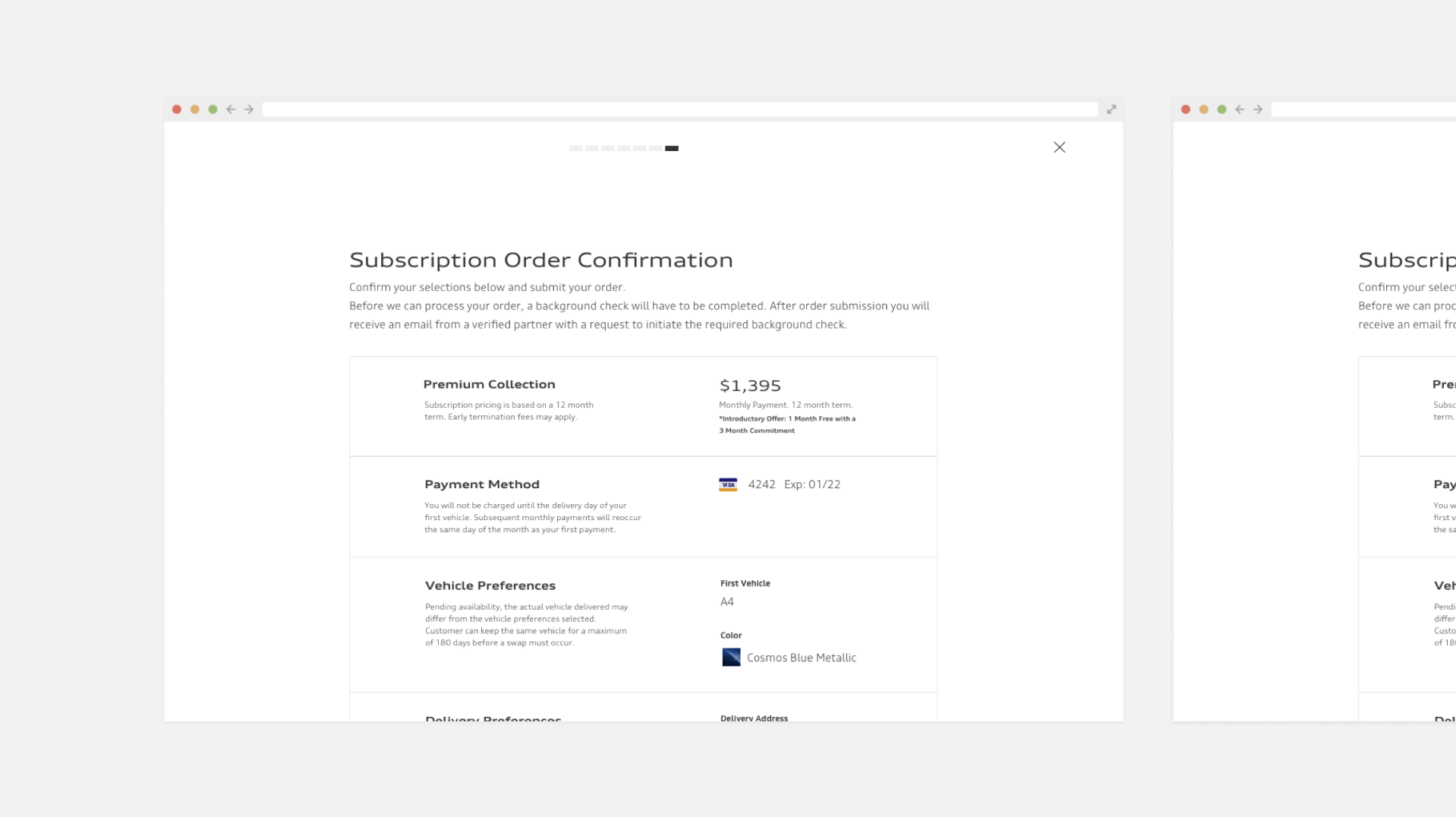
Following extensive user interviews, we confidently recommended Audi to proceed with the press releases and launch the Audi Select pilot. This was our final design.
Outcome
Audi select achieved a successful launch, surpassing its initial goal of acquiring 25 subscribers for the Premier Collection at the pilot location within 4 months, two months ahead of the six-month target. The program introduced the Core Collection at $995 monthly, which quickly generated a waiting list. Plans are underway for Audi select to expand into new markets.